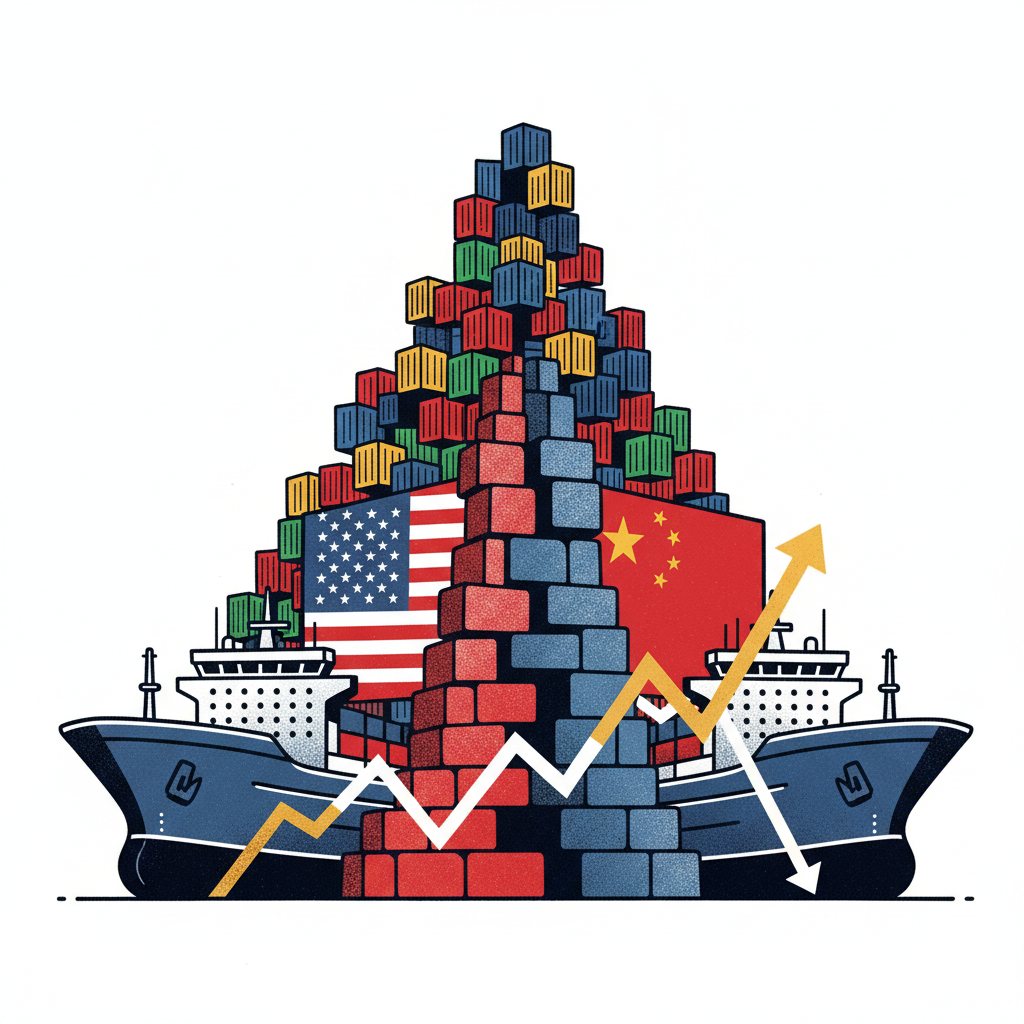
The Geopolitical Battle for Chip Supremacy
The ongoing trade conflict between the United States and China, initially characterized by tariffs on goods, has evolved into a strategic competition for technological supremacy, with semiconductors at its core. The US government views advanced microchips, especially those powering artificial intelligence and high-performance computing, as dual-use technologies critical for both economic leadership and national security. This perspective positions companies like Nvidia, a global leader in AI chip development, squarely in the crosshairs of geopolitical maneuvering.
Nvidia's operations are deeply affected by these dynamics. GeoGazet tracking reveals "Tariffs & Trade" as its top connection by signal volume with 70 tracked signals, followed by "China" with 45 signals and "United States" with 12 signals. These figures underscore the direct and significant impact of trade policies and national strategies on Nvidia's business environment. Despite a relatively low current influence score of 8/100, suggesting limited direct control over the political levers of the trade war, Nvidia is highly susceptible to its dynamics. The extensive reach of these trade dynamics is further illustrated by a total of 100 tracked events in the GeoGazet graph related to these geopolitical shifts.
Export Controls and Market Adjustments
The US Department of Commerce has implemented stringent export controls, requiring licenses for the sale of certain high-performance chips to China. These regulations specifically target GPUs that exceed particular processing and interconnect bandwidth thresholds, directly impacting Nvidia's ability to sell its most advanced products, such as its A100 and H100 chips, to Chinese customers. This mirrors historical technology denial regimes, akin to Cold War-era restrictions on advanced computing exports, though now focused on a commercial market rather than exclusively military applications.
In response, Nvidia has developed modified, "detuned" versions of its chips, like the H20 and L20 series, specifically designed to comply with US export restrictions while still serving the Chinese market. This necessity to re-engineer products for a major market highlights the profound commercial implications of the trade war. This anticipatory behavior, mirrored in GeoGazet tracking signals like "Retailers front-loading Chinese imports to beat looming July 24 tariff deadline (WMT:NASDAQ)" and "US retailers frontload China orders for holiday season, shipping firms say," illustrates the pervasive economic uncertainty driven by trade policies and how various industries are adapting to impending restrictions. Even European economies face similar challenges, as evidenced by the GeoGazet signal "Europe wants to rebalance trade with Beijing, but can't quit Chinese air conditioners," demonstrating the difficulty of decoupling from Chinese supply chains and markets.
What to Watch For Next
The future trajectory of Nvidia's entanglement hinges on several factors. Observers should monitor any further tightening or potential relaxation of US export controls, particularly concerning thresholds for advanced chip performance. The progress of China's indigenous semiconductor industry in developing competitive AI chips will also be critical, as will Nvidia's strategy for diversifying its global markets and research and development investments to mitigate risks associated with geopolitical tensions. Geopolitical shifts, including changes in bilateral relations or the emergence of new technology alliances, will continue to shape the operational landscape for Nvidia and the broader semiconductor industry.