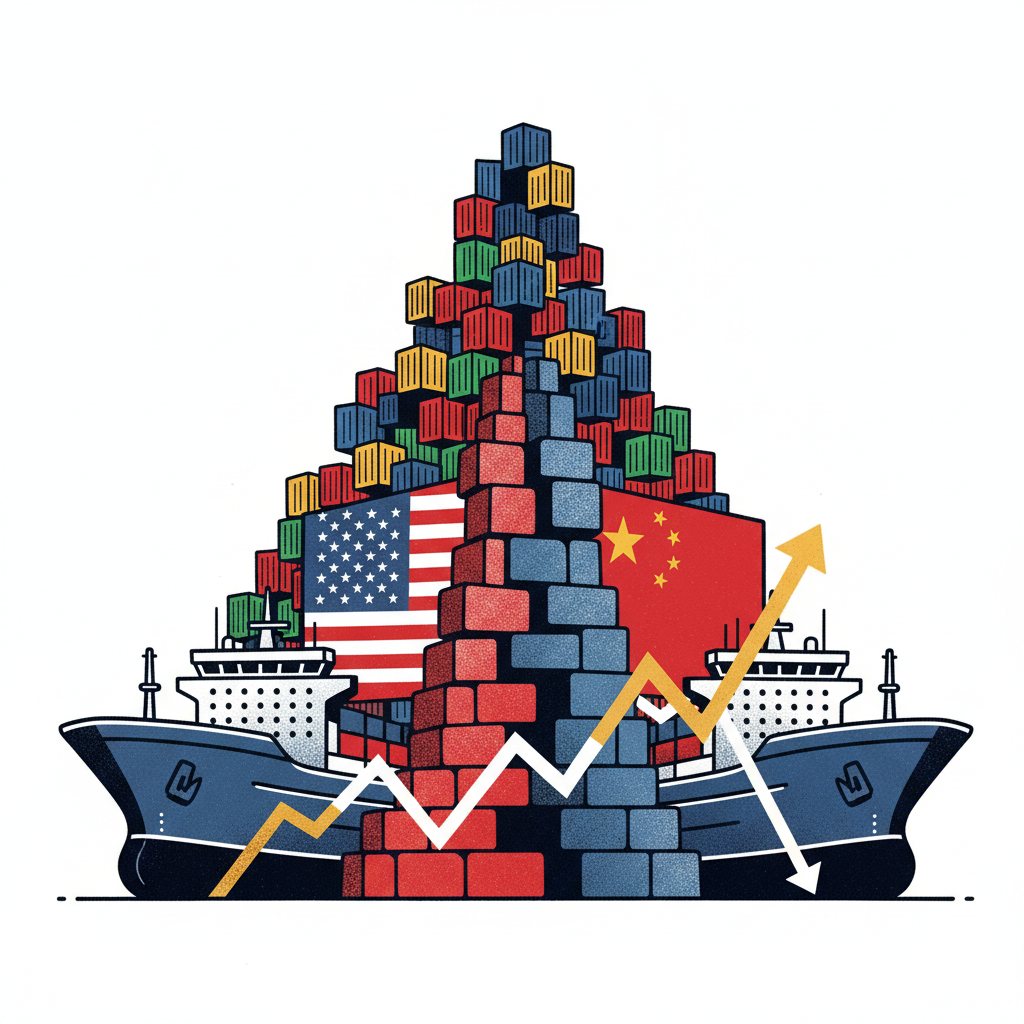
Origins of the US-China Trade Conflict
The US-China trade war, initiated in 2018 under the Trump administration, stemmed from a complex array of economic disputes. Key American concerns included China’s alleged theft of intellectual property, the requirement for foreign companies to transfer technology to Chinese partners, extensive state subsidies for Chinese industries, and barriers to market access for American firms. The substantial and persistent trade deficit with China was also a central point of contention, viewed as evidence of unfair trade practices. This period marked a shift from previous administrations' engagement strategies to a more confrontational approach, seeking to compel changes in China's economic policies. The intensity of this issue is reflected in GeoGazet tracking, where "Tariffs & Trade" represents the highest signal volume with 70 tracked signals, underscoring its prominence in global economic discourse.
Market Reactions and Economic Impact
Initial market reactions to the escalating tariffs were characterized by significant uncertainty and volatility. Stock markets experienced downturns as investors fretted over the potential for reduced corporate profits and global economic slowdowns. Supply chains, built over decades, faced considerable disruption, forcing companies to absorb tariff costs, adjust pricing, or explore new sourcing strategies. The ongoing nature of these costs and their varied impact is evident, as GeoGazet signals report "The costs of the Trump administration’s tariffs diverge for countries and industries so far in 2026." Despite these challenges, markets have shown resilience, with firms adapting by diversifying supply chains away from China or shifting production to other countries. The current influence score of 4/100 suggests that while the trade war remains a factor, its direct, acute market-moving impact may have lessened as economies have adjusted. Interestingly, "China’s monthly car exports top 1m for first time as overall trade soars" indicates China’s continued export strength and adaptation, potentially through reorienting its trade partners or increasing competitiveness in certain sectors even amidst Western protectionism. GeoGazet tracks "China" with 45 signals and "United States" with 10 signals, highlighting the sustained attention on China's trade dynamics.
Broader Geopolitical Context
The trade war is inextricably linked to a broader geopolitical rivalry between the United States and China, extending beyond economics to technology, national security, and regional influence. The US has continued to employ protectionist measures and trade penalties as tools of foreign policy, as evidenced by a recent GeoGazet signal stating, "US imposes new 25% tariffs on Brazil, expands exemptions list," indicating a broader trend in US trade policy. Historically, trade disputes have often been precursors or components of larger geopolitical shifts, reminiscent of earlier periods of economic nationalism. The current environment sees both nations vying for technological supremacy, particularly in critical areas like semiconductors and artificial intelligence, further complicating trade relations.
What to Watch For Next
Future developments will likely focus on the longevity and evolution of tariff regimes, the effectiveness of supply chain decoupling efforts, and China’s ongoing strategies to bolster its domestic economy and export capabilities. The increasing number of "Total tracked events in GeoGazet graph: 100" underscores the complexity of global trade and geopolitical dynamics. Observers should monitor policy shifts from both Washington and Beijing, particularly concerning technology export controls, investment restrictions, and efforts to build resilient supply chains independent of rivals.