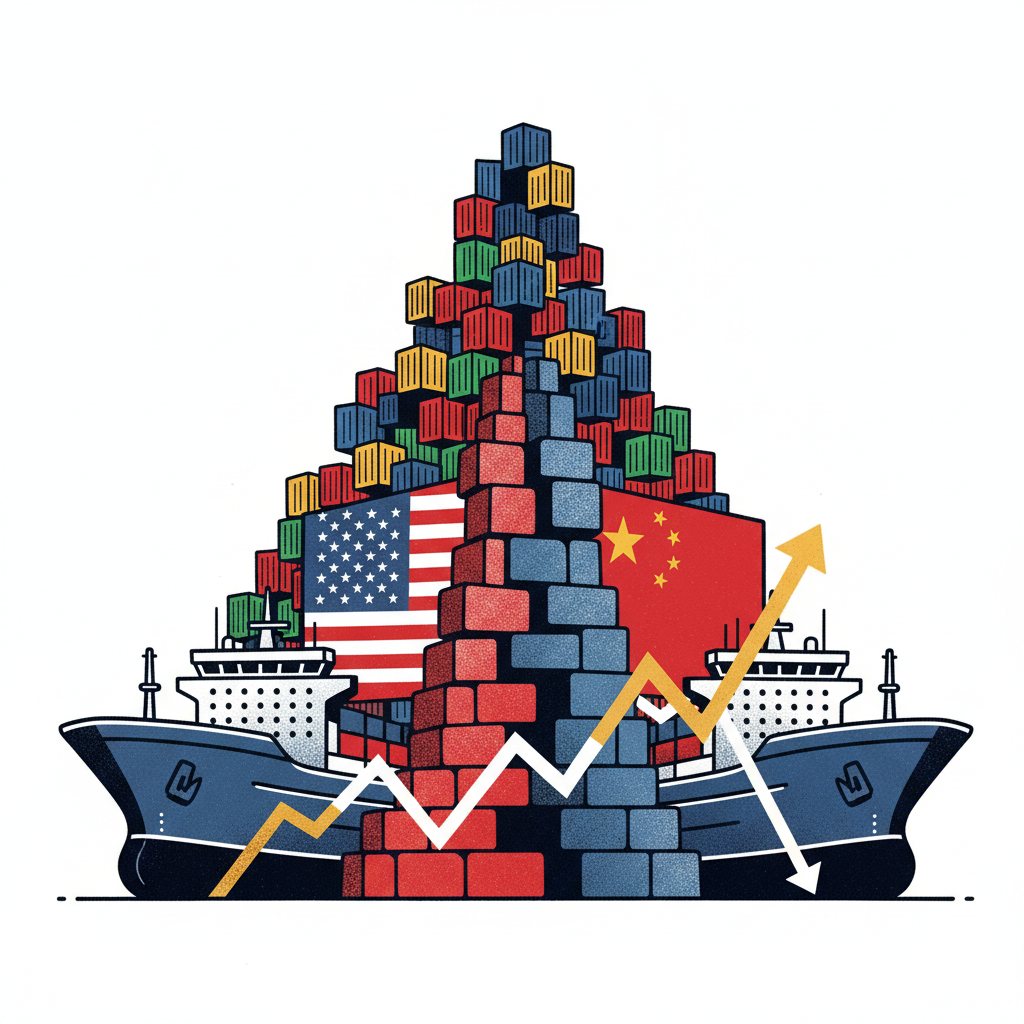
Context of the US-China Trade War
The US-China trade war, initiated in 2018, represents a significant facet of a broader strategic rivalry encompassing technological dominance, national security, and global influence. While initial rounds involved escalating tariffs on hundreds of billions of dollars worth of goods, followed by a "Phase One" trade deal, the underlying structural issues, such as intellectual property theft, forced technology transfer, and state subsidies, remain largely unaddressed. The current geopolitical landscape is characterized by increasing great power competition, with both nations pursuing policies aimed at securing supply chains, fostering domestic innovation, and reducing economic dependencies on the other. This dynamic ensures that trade policy is viewed through a lens of national security and strategic advantage.
Analysis of Current Signals and Data
GeoGazet tracking indicates a low "Current influence score" of 12/100 for the US-China trade war as a standalone global event, suggesting that while it is a constant, it may not be dominating global headlines compared to other crises. However, the consistent tracking of related topics underscores its enduring importance. "Tariffs & Trade" leads with 75 tracked signals, followed by "China" with 42 and "United States" with 11, indicating continuous monitoring of this specific bilateral interaction. The "Total tracked events in GeoGazet graph: 100" further emphasizes sustained analytical focus on the complex relationship.
Recent signals provide strong indications of a potential tariff re-escalation. As reported by GeoGazet tracking, "US tariffs could return to previous levels if Section 301 probes succeed: Bessent." This statement, coupled with another signal quoting Bessent directly: "Tariffs Will Snap Back to 'Exactly Where They Were' Before Supreme Court's IEEPA Ruling," strongly suggests that the United States is actively considering, and preparing for, a return to higher tariff levels. These statements point to ongoing reviews of trade practices under Section 301 of the Trade Act of 1974, which historically served as the legal basis for the initial tariffs. The signal "Soumaya Keynes on the right way to fight a trade war" also highlights ongoing strategic debate and planning regarding the most effective methods to exert trade pressure, indicating that the concept of a trade war is still very much an active strategic consideration, not a concluded event.
Historical Comparison and Future Trajectory
Historically, periods of perceived unfair trade practices have led to protectionist measures, with the 2018 US imposition of tariffs on Chinese goods being a prominent recent example. The current signals suggest a potential return to the conditions prior to the Supreme Court's IEEPA (International Emergency Economic Powers Act) ruling or preceding trade agreements, where tariffs were utilized more aggressively. This indicates that while the specific mechanisms may evolve, the underlying strategic intent to pressure China on trade imbalances and structural issues persists. The future trajectory is thus likely to involve targeted tariff actions, potentially expanding beyond traditional goods to encompass technology and critical minerals.
What to Watch For Next
To accurately forecast the US-China trade war, observers should closely monitor the outcomes of ongoing US Section 301 investigations into Chinese trade practices, particularly regarding steel, aluminum, and other strategic sectors. Official statements from US and Chinese trade representatives, any new tariff announcements, and the nature of China's retaliatory measures will be crucial indicators. Additionally, attention should be paid to global supply chain adjustments and the rhetoric surrounding "de-risking" or "decoupling" efforts by both nations, as these will directly influence the scope and intensity of future trade disputes.