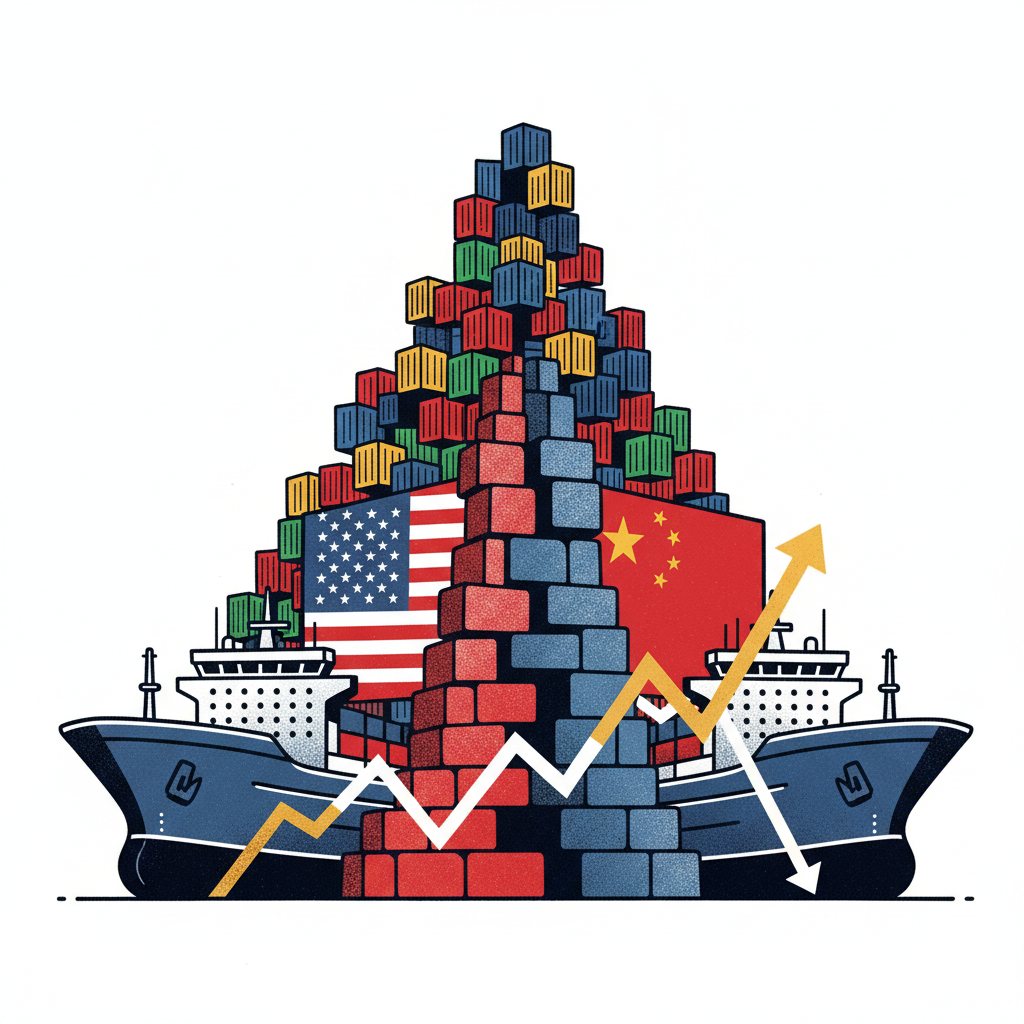
Context of the US-China Trade War
The US-China trade war formally began in 2018 under the Trump administration, with the United States imposing tariffs on Chinese goods, citing unfair trade practices, intellectual property theft, and forced technology transfers. China retaliated with its own tariffs on American products. This initial phase was marked by escalating duties and sporadic trade negotiations, aiming to rebalance trade deficits and address structural economic issues. The conflict, however, extended beyond tariffs, encompassing issues of technological dominance, exemplified by restrictions on companies like Huawei, and competition for influence in key regions.
Current Dynamics and Geopolitical Situation
The current geopolitical situation reflects a continuation of strategic competition, albeit with evolving tactics. While the direct tariff-for-tariff escalation of the initial trade war has somewhat stabilized, underlying tensions remain high. GeoGazet tracking indicates a current influence score of 4 out of 100 for this dynamic, suggesting that while the immediate, acute phase of tariff imposition may have subsided, the broader implications and ongoing competitive efforts continue to shape bilateral relations. GeoGazet’s top connections by signal volume underscore the ongoing relevance of these issues, with "Tariffs & Trade" registering 70 tracked signals, "China" 45 signals, and "United States" 11 signals, out of a total of 100 tracked events in the GeoGazet graph.
Recent signals from GeoGazet tracking highlight these nuanced dynamics. One signal notes, "The costs of the Trump administration’s tariffs diverge for countries and industries so far in 2026," indicating that the economic consequences of past tariff policies are still being assessed and vary significantly. Another signal points to China's economic resilience and evolving trade profile: "China’s monthly car exports top 1m for first time as overall trade soars," suggesting that despite external pressures, China continues to expand its global trade footprint, particularly in key manufacturing sectors. Furthermore, diplomatic channels appear to remain open even amid economic pressures, as evidenced by the signal, "US tariff probe unlikely to derail autumn Xi-Trump meeting: analysts." This suggests a commitment to managing the competition through dialogue, even if fundamental disagreements persist.
Historical Comparisons and Future Outlook
Historically, this competition can draw parallels to aspects of the Cold War era, where ideological differences were coupled with economic and technological rivalry, albeit without direct military conflict between the superpowers. Today, the competition is less ideological and more centered on economic interdependence and technological supremacy within a globalized framework.
Looking ahead, what to watch for next includes the outcomes of ongoing tariff probes and their potential impact on specific industries, the evolution of supply chain diversification efforts by both nations, and the frequency and substance of high-level diplomatic engagements. The interplay between economic competition and broader geopolitical objectives, particularly concerning Taiwan and regional security, will be critical determinants of the future trajectory of US-China relations.