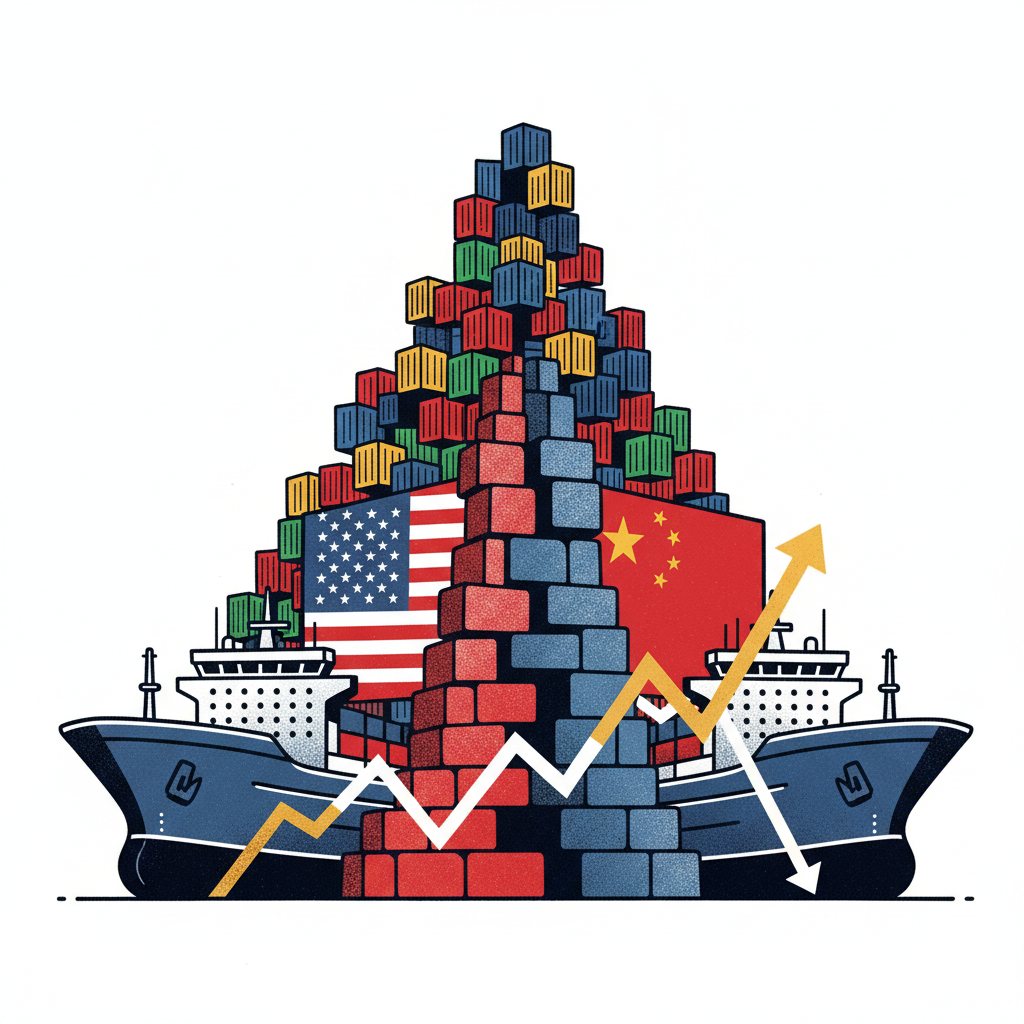
Current Status of Trade Tensions
The overall geopolitical influence score for today stands at 18/100, indicating a moderate, but not overwhelming, daily impact from US-China trade dynamics. However, analysis of signal volume reveals a focused attention on specific trade issues. "Tariffs & Trade" leads with 76 tracked signals, significantly higher than signals for "China" (41 tracked signals) and "United States" (12 tracked signals), underscoring the granular focus on this specific facet of the bilateral relationship. GeoGazet tracking shows a total of 100 tracked events, reflecting ongoing scrutiny.
Historically, the US-China trade war began with significant tariff imposition under the Trump administration in 2018, targeting billions of dollars in goods. The current situation echoes these historical tensions with new legal interpretations. A recent signal from GeoGazet tracking indicates "Bessent: Tariffs Will Snap Back to 'Exactly Where They Were' Before Supreme Court's IEEPA Ruling." This refers to potential tariff reinstatements linked to the International Emergency Economic Powers Act (IEEPA) and a Supreme Court decision, presenting a significant point of concern for businesses that may have adjusted operations post-tariff. The prospect of such a snap back introduces considerable uncertainty into trade planning.
Key Signals and Market Reactions
Conversely, signals also point to efforts towards de-escalation. GeoGazet tracking highlights that "China, US to discuss reciprocal tariff cuts under trade council, says commerce ministry." This development suggests a diplomatic avenue is being pursued, reminiscent of previous phases of the trade war where both sides sought common ground through negotiations. Such discussions would aim to reduce the economic friction that has characterized the relationship for years, potentially signaling a desire to stabilize the trade environment.
The impact of existing or potential tariffs on specific industries also features in current intelligence. Another GeoGazet signal notes that a "Chinese Copper Supplier Says US Demand Can Bear Trump’s Tariffs." This suggests that some sectors may have developed resilience or found alternative supply chains, or that the market demand in the United States remains strong enough to absorb the increased costs associated with tariffs. This indicates a complex economic adaptation by firms on both sides since the initial imposition of tariffs, potentially mitigating some of their intended punitive effects.
Forward Outlook
The immediate future of US-China trade relations hinges on the outcomes of the forthcoming trade council discussions regarding reciprocal tariff cuts. Attention will also be directed towards any further clarification or policy responses related to the Supreme Court's IEEPA ruling and its implications for tariff policy. Economic data from both the United States and China, particularly concerning import and export volumes in affected sectors, will provide crucial indicators of market resilience and the actual impact of ongoing or potential trade measures.