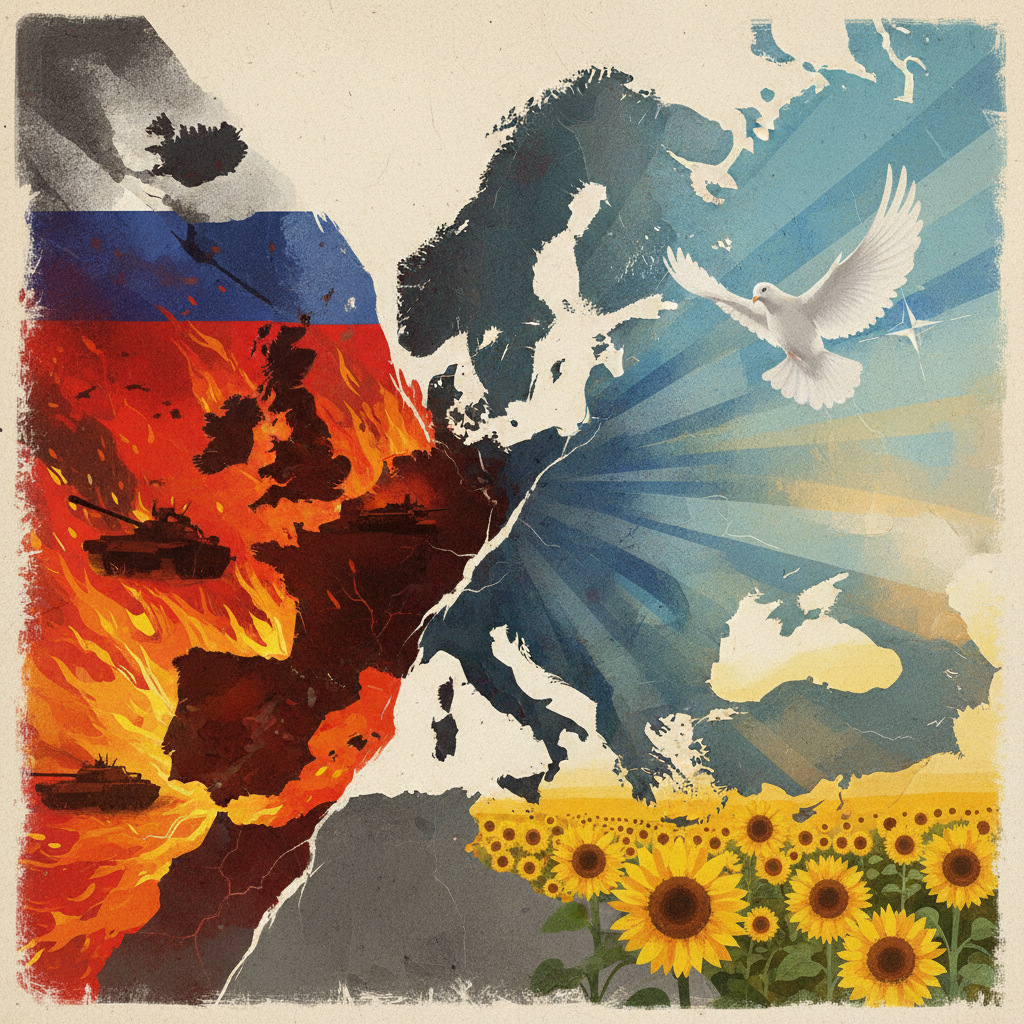
Ukraine War Predictions 2025: An Analytical Outlook
Current Geopolitical Context
The conflict in Ukraine remains a central point of global geopolitical analysis, registering a current influence score of 69/100, indicating its significant ongoing impact. Intelligence tracking services, such as GeoGazet, show sustained high signal volumes for key players and events: Ukraine (86 tracked signals), Russia (84 tracked signals), and Missiles & Strikes (21 tracked signals), underscoring the persistent kinetic activity and strategic focus on the region. The conflict has evolved into a grinding war of attrition, with front lines largely stabilized despite continuous fighting and long-range targeting efforts. GeoGazet's graph currently tracks 100 events related to the conflict, demonstrating its dynamic and multifaceted nature.
Military Dynamics and Operational Forecast
By 2025, the military landscape is expected to remain largely defined by advanced drone warfare and precision strikes. Recent events illustrate this trend, with GeoGazet tracking the signal, "Nine dead as Russia and Ukraine trade drone and missile salvos." This indicates the pervasive nature of aerial assaults, which will likely intensify as both sides innovate and scale up uncrewed aerial vehicle (UAV) capabilities. Ukraine's capacity to disrupt Russian logistics and naval operations is also a critical factor; for instance, the recent signal, "Ukrainian drone strikes force Russia to suspend shipping in Sea of Azov," highlights a successful strategy to exert pressure on Russia's Black Sea Fleet and supply routes. Such actions are crucial for Ukraine to offset numerical disadvantages and will be a key element of its operational strategy into 2025, aiming to degrade Russian capabilities and economic access. Historical comparisons to protracted conflicts, where technological innovations and asymmetric warfare played significant roles, suggest that such tactics can sustain pressure over extended periods without necessarily leading to immediate territorial gains.
Economic Pressures and Stability
The economic dimension is anticipated to play an increasingly critical role in shaping the conflict's duration and intensity by 2025. Russia's economy faces substantial long-term challenges. An intel report tracked by GeoGazet indicates, "Russian economy is an 'illusion' built on debt, and a banking crisis will explode." This assessment suggests that despite current resilience, underlying structural weaknesses and the cumulative effect of international sanctions could manifest as significant economic instability. A potential banking crisis could severely impede Russia's ability to finance its war efforts, impacting military production, troop morale, and overall societal stability. For Ukraine, continued Western financial and military assistance will be paramount to maintain its defense and national economy. Any shifts in international support due to domestic political changes in supporting nations could significantly alter Ukraine's capacity to resist. Historically, prolonged conflicts have often been decided as much by economic endurance as by military might, as seen in the latter stages of World War I or the eventual collapse of the Soviet Union due to internal economic strain.
What to Watch For Next
Key indicators to monitor include the stability of Russia's financial sector and its ability to sustain war production, the volume and consistency of international aid to Ukraine, and technological advancements in drone and anti-drone warfare. Additionally, internal political developments within both Ukraine and Russia, alongside shifts in global alliances, will be crucial in determining the conflict's trajectory through 2025.