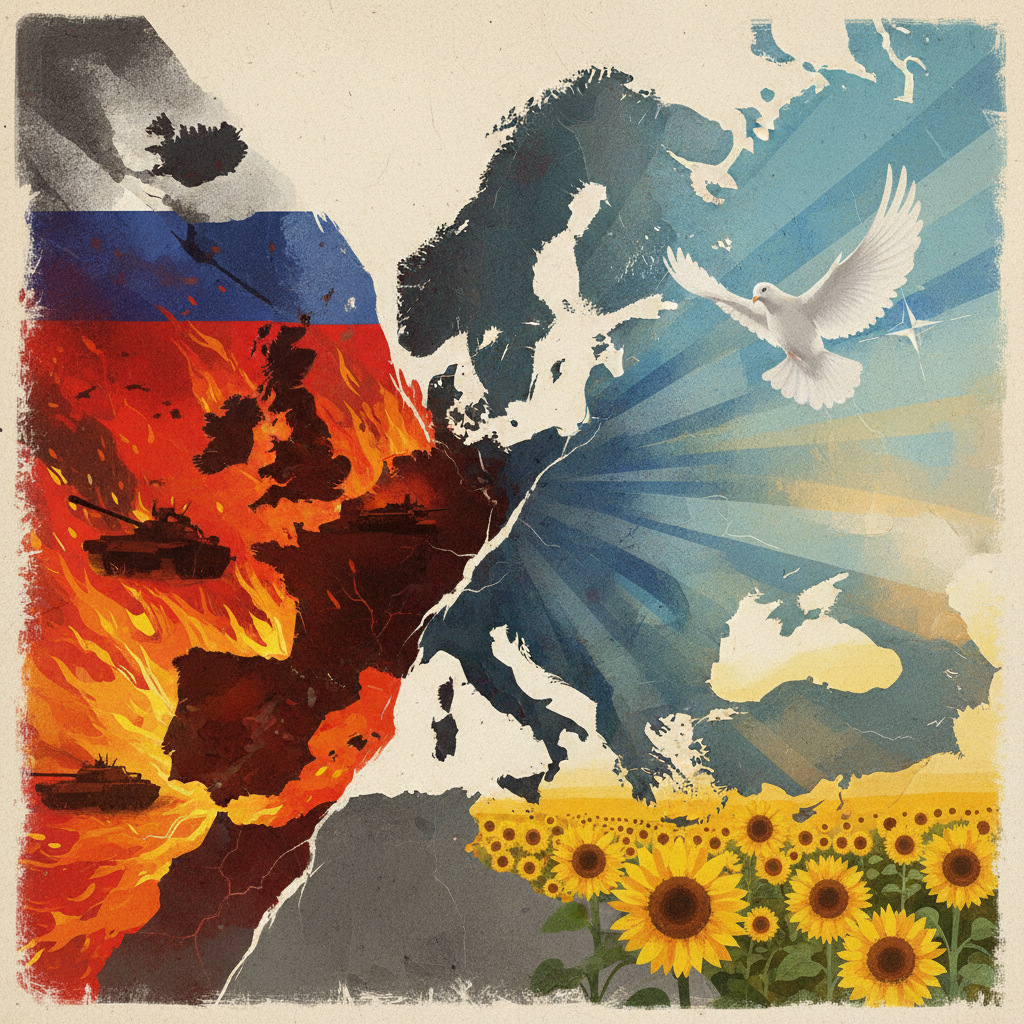
The conflict, initiated by Russia's full-scale invasion in February 2022, represents a foundational geopolitical challenge of the 21st century. Its global implications are underscored by a current influence score of 100/100, indicating pervasive worldwide impact on economies, security doctrines, and international relations. Geopolitical intelligence tracking highlights the centrality of the primary belligerents, with Russia registering 81 tracked signals and Ukraine 80 tracked signals, denoting their persistent engagement in the conflict.
Entrenched Strategic Objectives
Both Russia and Ukraine hold objectives that preclude an easy cessation of hostilities. Russia seeks to neutralize Ukraine's Western alignment, control significant territories, and diminish its sovereignty, viewing the conflict as a matter of national security and historical prerogative. Ukraine, conversely, fights for its territorial integrity, sovereignty, and the survival of its democratic governance, a fight strongly supported by Western nations. This fundamental clash of existential interests ensures neither side is willing to cede ground without significant military pressure or political capitulation, an outcome currently out of reach for either party.
Military Stalemate and Attrition
The war has largely evolved into a positional conflict characterized by extensive trench lines, artillery duels, and drone warfare. Despite significant pushes, neither side has demonstrated the capability to achieve a breakthrough that would fundamentally alter the front lines. The intensity of kinetic activity remains high, evidenced by "Missiles & Strikes" being a top connection with 12 tracked signals, indicating persistent engagement in offensive and defensive operations. GeoGazet tracking shows this continuous exchange, such as "Ukraine says it struck Russian missile electronics plant," and tragically, "A Russian drone strike in Ukraine kills 3 from one family, including a 13-year-old boy," illustrating the ongoing reciprocal violence and its human cost. The total of 100 tracked events in the GeoGazet graph further exemplifies the relentless nature of the conflict.
External Support and Resource Resilience
Ukraine's ability to resist the larger Russian military force is heavily reliant on sustained military, financial, and humanitarian aid from Western allies. This assistance, encompassing advanced weaponry, intelligence sharing, and economic support, has enabled Ukraine to maintain its defensive posture and conduct counteroffensives. Simultaneously, Russia has demonstrated a remarkable capacity to sustain its war effort despite extensive international sanctions. Its command economy shifts, existing stockpiles, and ability to procure key components, sometimes through third parties, allow it to continue producing armaments and maintaining troop numbers. This balance of external support for Ukraine and internal resilience for Russia contributes significantly to the war's prolonged duration.
Historical Parallels and Modern Warfare Dynamics
The prolonged nature of the Ukraine War echoes historical conflicts where deeply entrenched political objectives and external interventions led to extended periods of fighting, such as the Korean War or elements of the Cold War proxy conflicts. Modern warfare dynamics, including advanced surveillance, precision long-range strike capabilities, and widespread drone use, complicate rapid advances while simultaneously inflicting continuous damage. These technological factors contribute to a high-intensity, yet often static, conflict environment.
What to Watch For Next
Future developments hinge on the sustainability of Western support for Ukraine, Russia's ability to maintain its war economy and troop mobilization, and potential shifts in battlefield dynamics, particularly regarding air superiority and long-range strike capabilities. Any significant technological introduction or substantial political change in supporting nations could alter the conflict's trajectory.