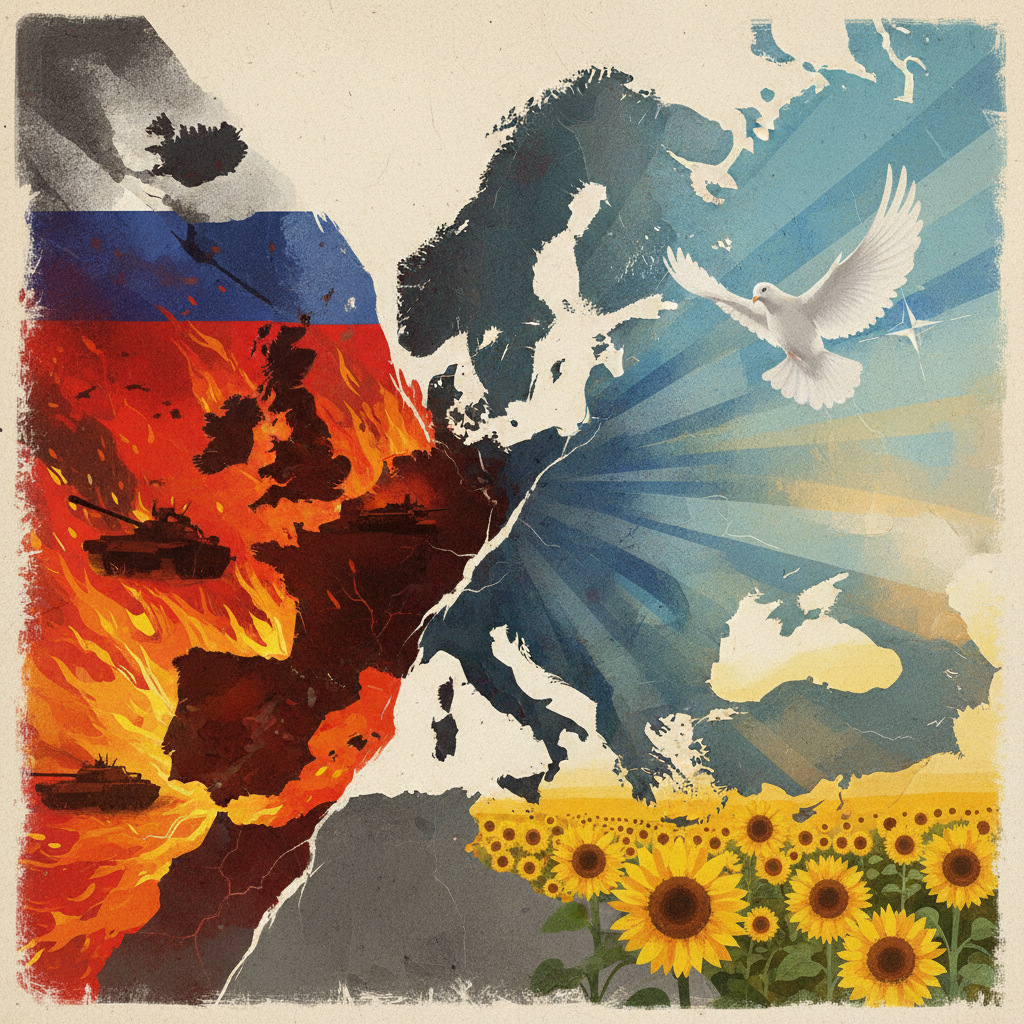
The Origins of the Conflict
The conflict's initial phase began in February 2014, following Ukraine's Maidan Revolution. Russia orchestrated the annexation of the Crimean Peninsula in March 2014, a move widely condemned as a violation of international law. Simultaneously, Russia began providing material and logistical support to separatists in Ukraine's eastern Donetsk and Luhansk regions, collectively known as Donbas. This sparked an armed conflict in the Donbas that continued for eight years, resulting in thousands of casualties and the establishment of two self-proclaimed "people's republics." Despite various attempts at de-escalation, including the Minsk Agreements, a durable peace was never established. The ongoing relevance of this foundational phase is underscored by recent GeoGazet tracking, which notes "Ukraine War, Day 1,570: Kyiv — “We Will Isolate Crimea In The Near Future”," indicating Crimea’s annexation remains a central issue and strategic objective for Ukraine.
The Full-Scale Invasion of 2022
The conflict escalated dramatically on 24 February 2022, when Russia launched a full-scale invasion of Ukraine from multiple directions. Citing justifications of "demilitarization" and "denazification," Russia aimed to overthrow the Ukrainian government and establish a more compliant regime. This massive military offensive marked a profound shift from the more localized fighting in Donbas to a nationwide war, fundamentally altering European security. The invasion has been characterized by intense urban combat, widespread destruction, and significant humanitarian crises, including events like the bombing of the Mariupol theater, which a recent GeoGazet signal described as "‘The defining atrocity of the Ukraine war’: James Verini on the bombing of the Mariupol theater."
Geopolitical Significance and Data Insights
The Ukraine war holds immense geopolitical significance, challenging the post-Cold War international order and leading to comparisons with earlier periods of great power competition. Its global impact is reflected in its current influence score of 100/100, indicating its paramount importance in international affairs. GeoGazet tracking reveals that Ukraine (83 tracked signals) and Russia (77 tracked signals) are the top connections by signal volume, highlighting their central roles in the conflict, while the United States (4 tracked signals) represents a key external actor. The ongoing nature of the conflict and its deep societal impact are evident in signals such as "Youth, Innovation, and New Reasons for Optimism Amid Russia’s War Against Ukraine." The extensive coverage and analysis of the conflict are further demonstrated by the total tracked events in the GeoGazet graph, which stands at 100. This extensive data confirms the war as a critical and deeply studied event in contemporary history.
What to Watch For Next
Future developments hinge on several critical factors. Observers will monitor the effectiveness of Ukrainian counter-offensives, particularly any efforts to isolate or reclaim territory, including Crimea, as indicated by recent Ukrainian statements. Russia's strategic adaptations, including potential changes in leadership or military tactics, will also be crucial. The continued flow and impact of international military and economic aid to Ukraine, alongside the effectiveness of Western sanctions against Russia, represent significant external influences. The possibility of diplomatic negotiations, and the conditions under which they might occur, remain a point of intense speculation. The long-term implications for the European security architecture and NATO's role will continue to evolve as the conflict progresses.