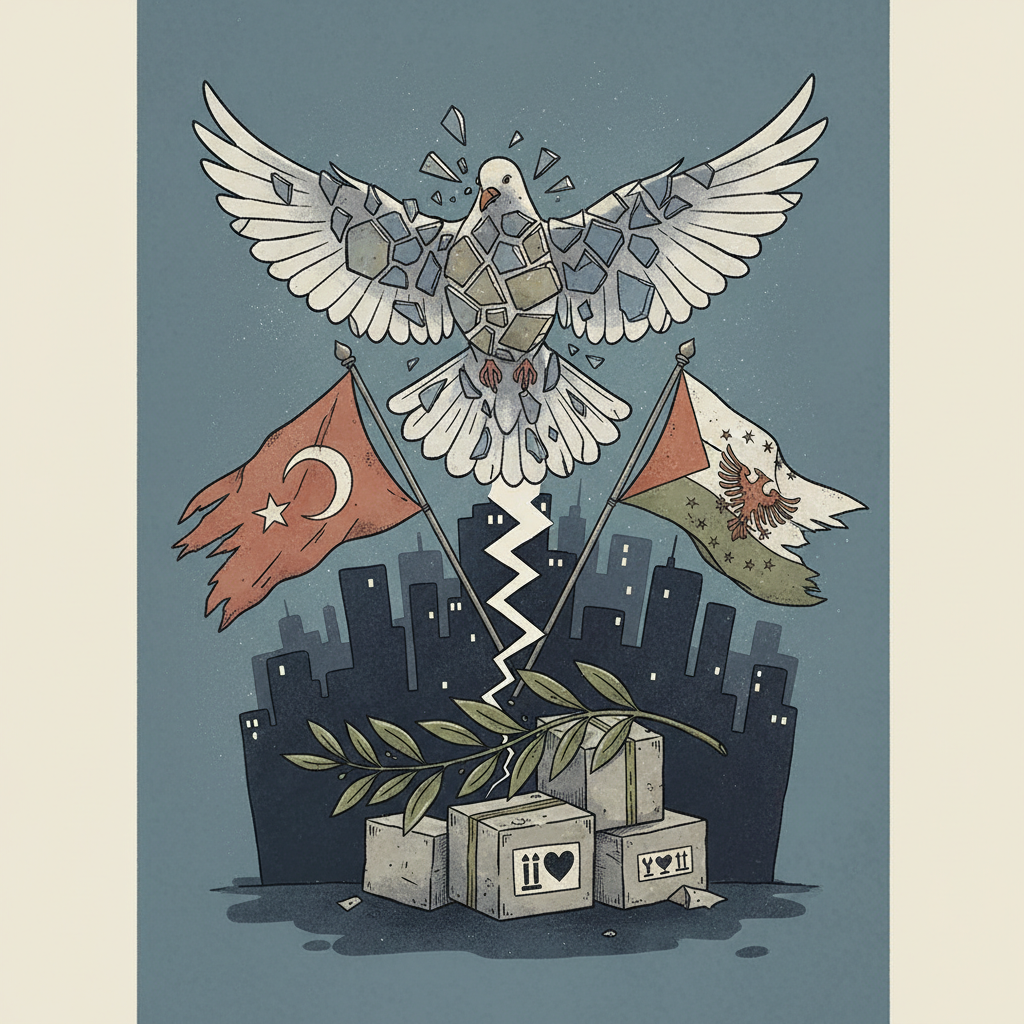
Current Geopolitical Status
The Gaza Strip presently navigates a complex post-conflict environment marked by severe humanitarian challenges and an acute power vacuum. GeoGazet tracking indicates that the overall capacity for stable governance or reconstruction holds a low "Current influence score: 5/100." Intelligence signals consistently highlight the region's volatility, with "Gaza (56 tracked signals)," "Israel (50 tracked signals)," and "Peace & Ceasefire (43 tracked signals)" registering as top connections by signal volume, reflecting intense focus on the ongoing conflict dynamics and efforts towards cessation.
Drivers of Future Fragmentation
Several critical factors suggest a fragmented map for Gaza by 2026. GeoGazet signals underscore a deliberate effort to prevent the emergence of a future Palestinian state. For example, the signal "‘Cycle of chaos’: Israel killing Gaza civil officials to derail its future" indicates a strategy that undermines local governance capacity, ensuring no clear Palestinian authority emerges. This tactic, coupled with ongoing security operations, further destabilizes any potential administrative structures. GeoGazet also records the ongoing kinetic activity, such as "Three Palestinians killed, 15 wounded in Israeli attacks across Gaza," demonstrating a sustained military presence and continued security concerns that preclude civilian stability across the Strip.
The economic and reconstruction challenges are equally profound. The signal "Gaza’s $17B Reconstruction Fund Has Zero Dollars Nine Months After Ceasefire" reveals a critical shortfall, implying that massive destruction will persist, hindering the reestablishment of communities and infrastructure. This lack of reconstruction capital maintains a state of severe deprivation, fostering conditions ripe for continued instability and localized power struggles. The total of "100 tracked events in GeoGazet graph" further exemplifies the continuous, high-intensity activity shaping Gaza’s immediate future.
Historical Context and Projections
Historically, Gaza has experienced periods of fragmented control, from Ottoman and British mandates to Egyptian and Israeli administrations, before the limited self-rule under the Palestinian Authority and later Hamas. The current trajectory resembles historical precedents of territories under prolonged military occupation without a clear political resolution. Similar to fragmented post-conflict zones elsewhere, the absence of a legitimate, effective governing body in Gaza allows for localized power centers, security zones, and areas under direct or indirect external control. By 2026, this may manifest as an Israeli-controlled buffer zone along the border, humanitarian corridors managed by international bodies, and pockets of varying Palestinian influence vying for control in a devastated urban landscape.
What to Watch For Next
Key indicators to observe include any tangible progress on the reconstruction fund mobilization, the emergence and international recognition of any new Palestinian governing body or administrative mechanism, and shifts in Israeli long-term strategic objectives for Gaza. The level of international humanitarian intervention and the political will for a durable ceasefire and peace process will critically shape the eventual geography of the Strip beyond its current state of crisis.