Immediate Economic Repercussions
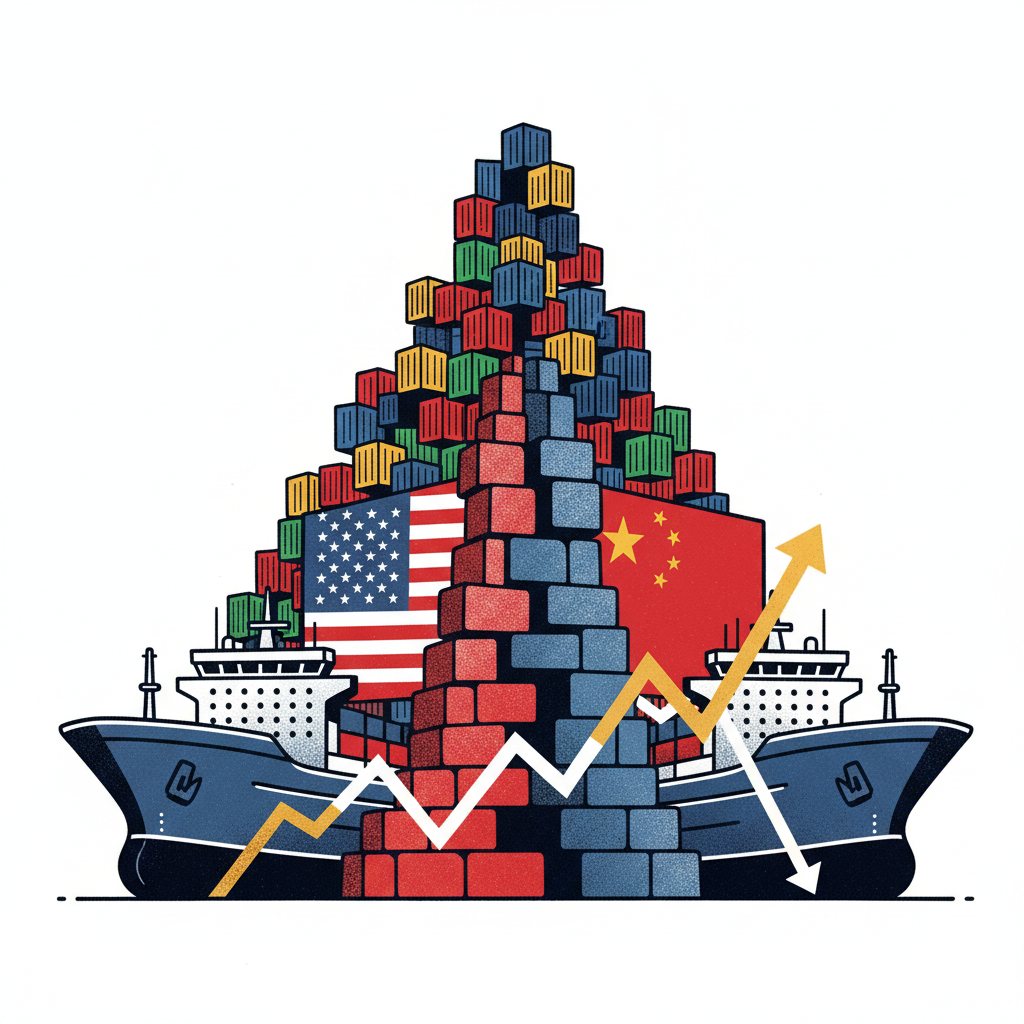
Escalated trade hostilities would first manifest as increased costs for businesses and consumers globally. Tariffs, effectively taxes on imports, are typically passed along the supply chain, impacting end prices. Signals tracked by GeoGazet reveal 'Tariffs & Trade' as the most prominent connection, registering 78 tracked signals, followed by 'China' with 38 and 'United States' with 13, underscoring the persistent focus on these issues. GeoGazet's recent report, "Trump's New US Tariff Wall Shakes Up Winners, Losers Lineup," indicates a potential for renewed US tariff applications, suggesting that previous trade war dynamics could re-emerge. Similarly, China's retaliatory capacity is evident in "China Slaps Restrictions on Dozens of U.S. Companies," demonstrating its willingness to engage in punitive measures. While the current 'influence score' for direct trade war escalation stands at 17/100, reflecting perhaps a period of cautious de-escalation, the potential for rapid escalation remains high given underlying structural tensions. The GeoGazet tracking graph registers 100 total tracked events related to these dynamics, illustrating the ongoing complexity.
Global Supply Chain Restructuring
A full-blown trade war would accelerate the "de-risking" or even "decoupling" trends already underway. Companies would be compelled to diversify sourcing away from China or the United States, leading to costly and inefficient reconfigurations of global supply chains. This shift prioritizes resilience and political alignment over pure economic efficiency, potentially resulting in higher production costs and inflationary pressures across various sectors. The focus on specific regulatory tools, highlighted by the signal "Trump’s ‘Forced Labor’ Tariffs: If At First You Don’t Succeed . . .", shows how human rights and labor concerns are intertwined with trade policy, adding another layer of complexity to supply chain decisions. This forced restructuring would disproportionately affect countries heavily integrated into the existing US-China manufacturing ecosystem, potentially creating new winners and losers.
Geopolitical Fragmentation and De-Risking
Beyond economics, a trade war exacerbates geopolitical tensions, compelling third-party countries to align more closely with one economic bloc or the other. This risks fragmenting the global economic order into competing spheres of influence. The historical precedent of the Smoot-Hawley Tariff Act of 1930 provides a stark warning; its contribution to global trade collapse and the Great Depression illustrates how protectionist spirals can destabilize international relations and economic prosperity. While today's global economy is more integrated, the principles of retaliatory tariffs and reduced trade flows remain potent threats.
Historical Precedents and Future Outlook
The current geopolitical situation, characterized by strategic competition between the US and China over technology, security, and economic influence, suggests that trade tools will remain central to statecraft. While direct large-scale tariff walls have seen some de-escalation, targeted restrictions, export controls, and investment screening are increasingly utilized.
To monitor the situation, observers should watch for:
- The rhetoric and policy proposals from upcoming US election cycles, particularly regarding trade with China.
- The continued evolution of "de-risking" strategies by major multinational corporations and their practical implementation.
- Further targeted restrictions on critical sectors, such as semiconductors, artificial intelligence, and green technologies, by either nation.
- Responses and policy shifts from key allied economies, including the European Union, Japan, and ASEAN nations, as they navigate heightened US-China friction.