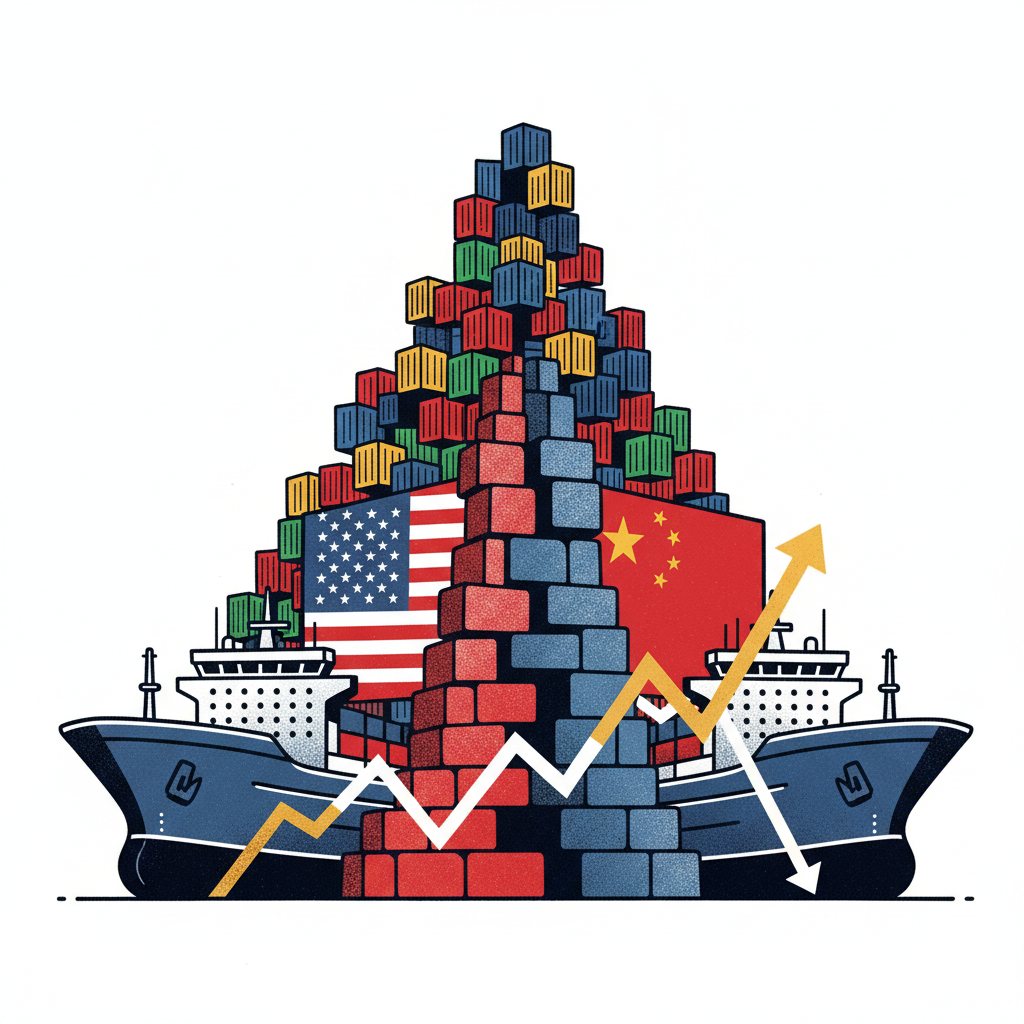
Begun in 2018 under the Trump administration, the trade conflict initially imposed significant tariffs on billions of dollars worth of goods from both nations. While initially framed as a means to address trade deficits and intellectual property theft, the dispute has since expanded to encompass technological dominance, supply chain resilience, and geopolitical influence. The current influence score of 26/100 on the overall US-China relationship suggests persistent tension and a low degree of resolution regarding these systemic issues.
Persistent Tariff Dynamics
The ongoing nature of tariff implementation and legal challenges underscores the protracted character of the trade war. GeoGazet tracking indicates that "Tariffs & Trade" leads in signal volume with 81 tracked signals, significantly higher than "China" (38 signals) or "United States" (14 signals), highlighting the centrality of tariff policies in the current discourse. Recent signals from GeoGazet further illustrate this complexity. One signal, "Trump’s Replacement Tariffs Will Have Unintended Consequences for USMCA," indicates how tariff policies, even proposed or alternative ones, continue to reshape global trade relations beyond direct US-China interactions. Another, "Trump's Tariffs, Government Revenue, and the Cost of Living: The Case of Food and the Agricultural Tariff Exemptions," points to the deep economic impacts and policy adjustments triggered by these measures. Furthermore, the signal "US appeals court extends block on ruling against Trump's 10% global tariff" demonstrates the persistent legal battles and policy uncertainty surrounding existing or past tariff decisions. With 100 total tracked events in the GeoGazet graph, the sheer volume of activity confirms that these issues are dynamic and far from settled.
Broader Geopolitical Landscape
The US-China trade war cannot be isolated from the broader geopolitical competition between the two powers. Historically, trade disputes have often been symptoms of deeper political or strategic rivalries, as seen in various instances during the Cold War where economic leverage was used as a tool of statecraft. Today, the competition extends to critical technologies like semiconductors, artificial intelligence, and quantum computing, as well as debates over human rights, regional security in the Indo-Pacific, and influence within international institutions. Both Washington and Beijing view aspects of the trade conflict through a national security lens, making comprehensive de-escalation difficult. The focus is no longer solely on reducing bilateral trade deficits, but on strategic decoupling in sensitive sectors and securing resilient supply chains, a shift that complicates any simple "end" to the conflict.
What to Watch For Next
Future developments hinge on several critical factors. These include the outcomes of US presidential election cycles, which could alter the approach to trade and foreign policy, and the economic performance of both nations. Technological advancements and the ongoing race for dominance in emerging industries will continue to shape competition. Additionally, any major geopolitical events, particularly concerning Taiwan or the South China Sea, could further entrench or shift the trajectory of US-China economic relations. The evolving efforts by both countries to build resilient alliances and economic blocs will also be key indicators of the long-term strategic direction.