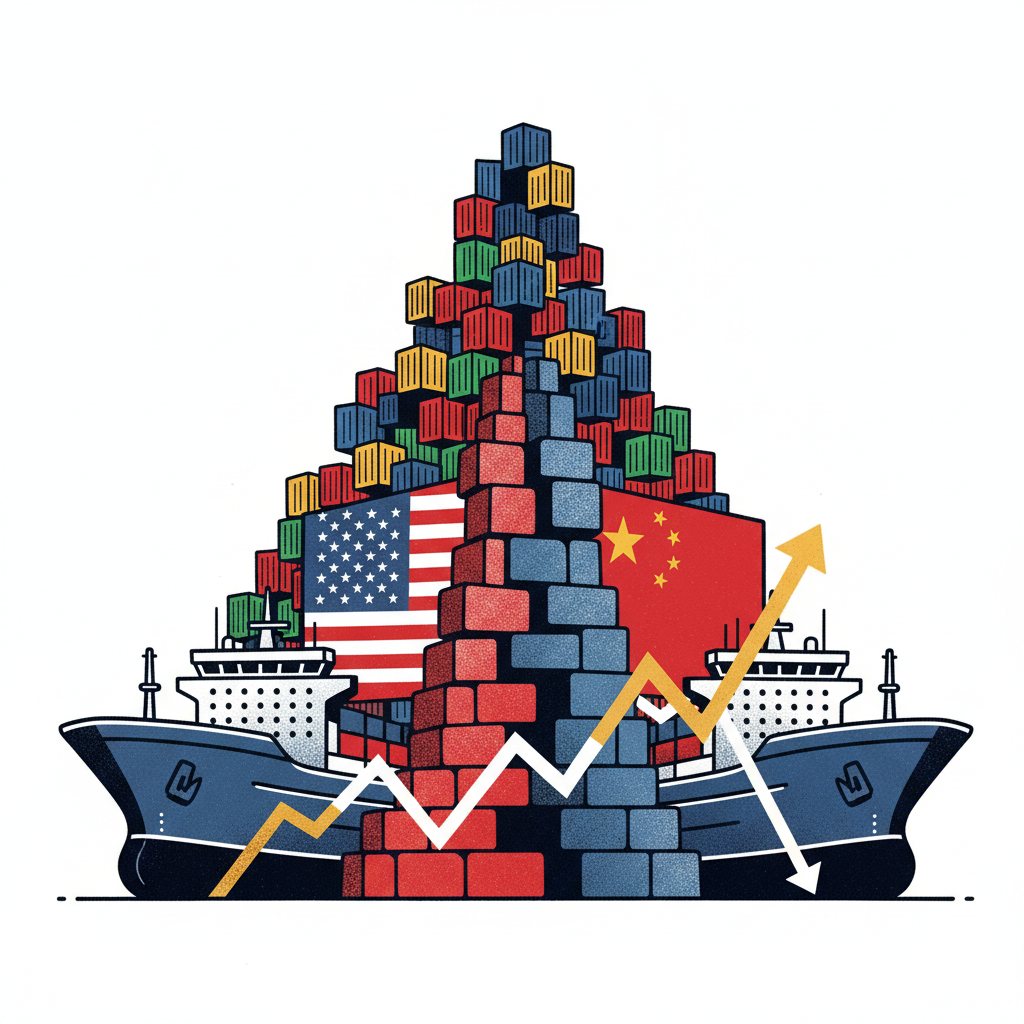
The initial phase of the US-China trade war, which began in 2018, involved reciprocal tariff increases on hundreds of billions of dollars worth of goods. This approach has evolved into a more nuanced strategy focused on "de-risking" supply chains and strategic competition, particularly in advanced technologies. The geopolitical landscape influences this, with broader tensions over Taiwan, human rights, and regional influence shaping economic policy. The current influence score for the US-China trade war stands at 13/100, suggesting that while underlying tensions remain, the situation is not at a peak of active escalation but rather a persistent state of strategic recalibration.
Current State of Trade Friction
The present dynamic between the United States and China primarily involves strategic economic competition rather than a full-scale tariff war. GeoGazet tracking indicates "Tariffs & Trade" as the top connection by signal volume, registering 78 tracked signals, followed by "China" with 37 and "United States" with 12. This data underscores that trade policies and their implications remain a central focus, with China being the primary subject of these observations.
Evidence from GeoGazet tracking provides specific insights. The signal "A Year After "Liberation Day," China Rerouted Its Exports and Taiwan Expanded Its Tech Footprint" illustrates ongoing supply chain diversification. This indicates China's active measures to reconfigure its export routes, potentially to mitigate existing or anticipated US trade restrictions, while Taiwan capitalizes on shifts in the technology sector. This re-routing is a direct response to persistent trade friction.
Uneven Economic Impact and Corporate Adaptation
The economic ramifications of the US-China trade war extend beyond the two primary actors. The GeoGazet signal "US-China Tariff War: Why Third-Country Gains Are Uneven" highlights that while some nations may benefit from supply chain shifts, these gains are not uniform. This suggests a complex global economic reordering where certain economies find new opportunities as businesses seek alternatives to China-centric manufacturing, while others face new challenges.
Corporations are actively implementing strategies to navigate this complex environment. The signal "How to Tariff-Proof Your Supply Chain Before the Next Policy Shift" indicates a proactive stance by businesses. Companies are investing in diversified manufacturing bases, near-shoring, or friend-shoring to build resilience against future policy changes. This ongoing effort to "tariff-proof" supply chains suggests an expectation of continued trade policy volatility between the US and China. GeoGazet currently tracks a total of 100 events related to this broader economic friction, reflecting the steady flow of related developments.
Historical Context and Future Outlook
Historically, the trade war initiated with broad tariffs on various goods, primarily under the Trump administration. The current phase, however, appears to be less about increasing the volume of tariffs and more about targeted restrictions, particularly in sensitive technology sectors such as semiconductors and artificial intelligence. This represents a strategic shift from a blunt force approach to a more precision-guided economic competition. The emphasis is on de-risking and reducing dependency in critical areas rather than a blanket decoupling.
What to watch for next includes any new US or Chinese policy announcements concerning technology export controls, investment restrictions, and subsidies for domestic industries. Observer nations should also monitor the pace of supply chain diversification efforts, particularly how effectively companies can implement tariff-proofing strategies. The evolution of multilateral trade agreements that might circumvent bilateral tensions will also be a key indicator of future directions in US-China economic relations. The low influence score suggests a stable, albeit complex, status quo rather than an impending dramatic shift, but targeted actions remain a constant watchpoint.