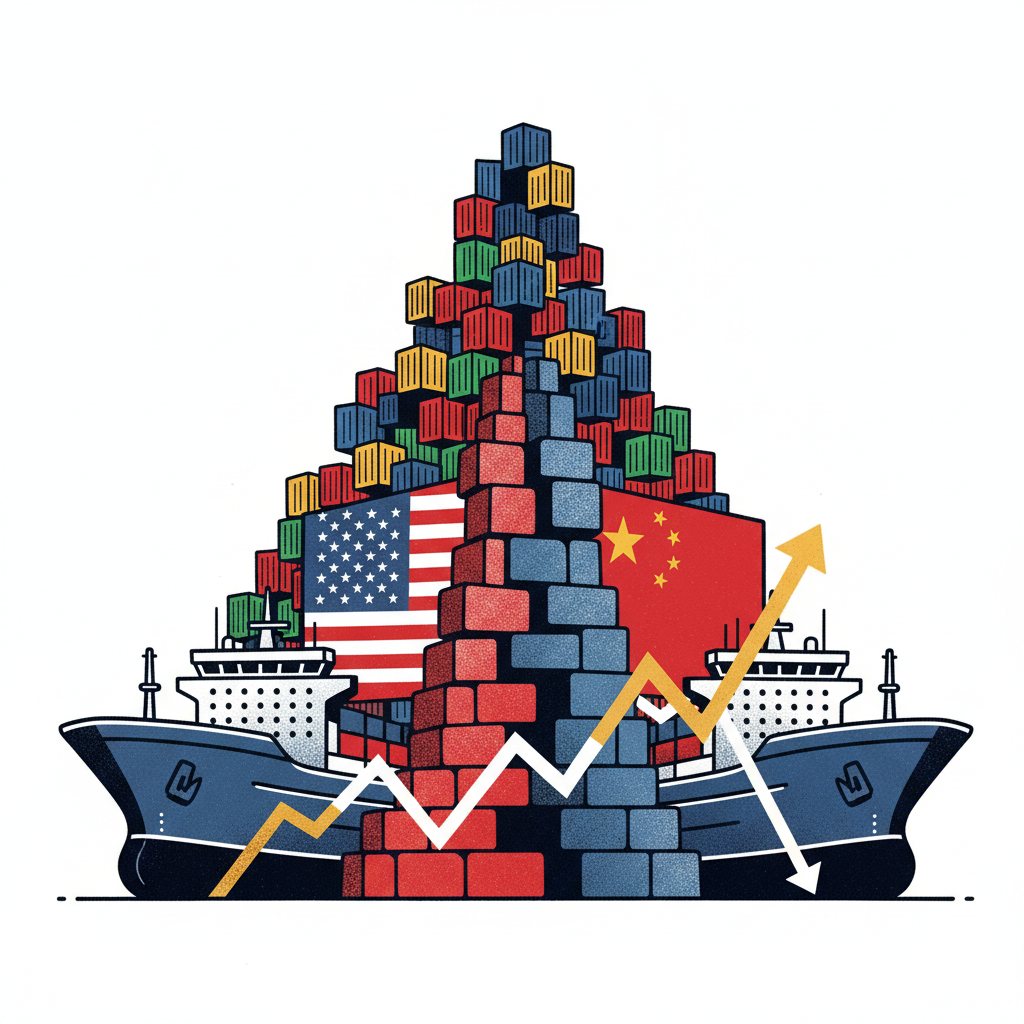
Historical Context of the US-China Trade War
The US-China trade war formally commenced in 2018 under the Trump administration, primarily driven by concerns over intellectual property theft, forced technology transfer, and a significant trade deficit. This period witnessed the implementation of extensive tariffs on hundreds of billions of dollars worth of goods by both nations. The initial phase was characterized by a rapid succession of tit-for-tat tariff increases, creating an atmosphere of overt economic conflict aimed at compelling fundamental changes in China's trade practices and market access.
Current State of Trade Relations
While the intense rhetoric of a "trade war" has largely subsided, many of the specific tariffs imposed during that era remain in place. GeoGazet tracking indicates that "The costs of the Trump administration’s tariffs diverge for countries and industries so far in 2026," highlighting the enduring, yet varied, economic consequences of these measures. Despite the low influence score for the specific trade war narrative (4/100), trade as a broader topic remains a significant area of geopolitical focus. "Tariffs & Trade" registers 70 tracked signals, "China" 45, and "United States" 11 as top connections by signal volume, demonstrating continued, but re-contextualized, attention to these economic interactions.
The nature of bilateral trade has also adapted. Recent signals from GeoGazet, such as "China’s monthly car exports top 1m for first time as overall trade soars," illustrate China's robust global trade performance in certain sectors, suggesting that while trade barriers exist, they do not uniformly impede all aspects of bilateral commerce or China's broader economic engagement. Furthermore, analysis indicates a "US tariff probe unlikely to derail autumn Xi-Trump meeting: analysts," suggesting that targeted trade actions are now more likely to coexist with high-level diplomatic engagement rather than unilaterally halt it. This contrasts sharply with the earlier trade war phase, where tariff announcements frequently preceded or overshadowed negotiation attempts. The total tracked events in the GeoGazet graph, numbering 100, reflect the complex and evolving nature of the US-China relationship.
Broader Geopolitical Context
The current US-China relationship extends far beyond the narrow definition of a trade war, evolving into a multifaceted strategic competition. Beyond tariffs, friction points include technological competition, particularly in semiconductors and artificial intelligence; human rights concerns; the status of Taiwan; and geopolitical influence in the Indo-Pacific. Trade policy is increasingly viewed through the lens of national security and strategic "decoupling" or "de-risking" in critical sectors, rather than solely as a means to address trade imbalances. This represents a significant shift from the initial trade war, where broad economic leverage was the primary tool.
What to Watch For Next
Future developments will likely center on the targeted application of trade tools, such as export controls and investment restrictions, particularly in high-tech sectors, rather than broad tariff escalations. Monitoring the outcomes of high-level diplomatic meetings, the evolution of supply chain resilience strategies in both countries, and the impact of domestic economic pressures on trade policy will be crucial. The potential for further "de-risking" initiatives or "small yard, high fence" approaches in critical technologies will define the next phase of US-China economic interaction.