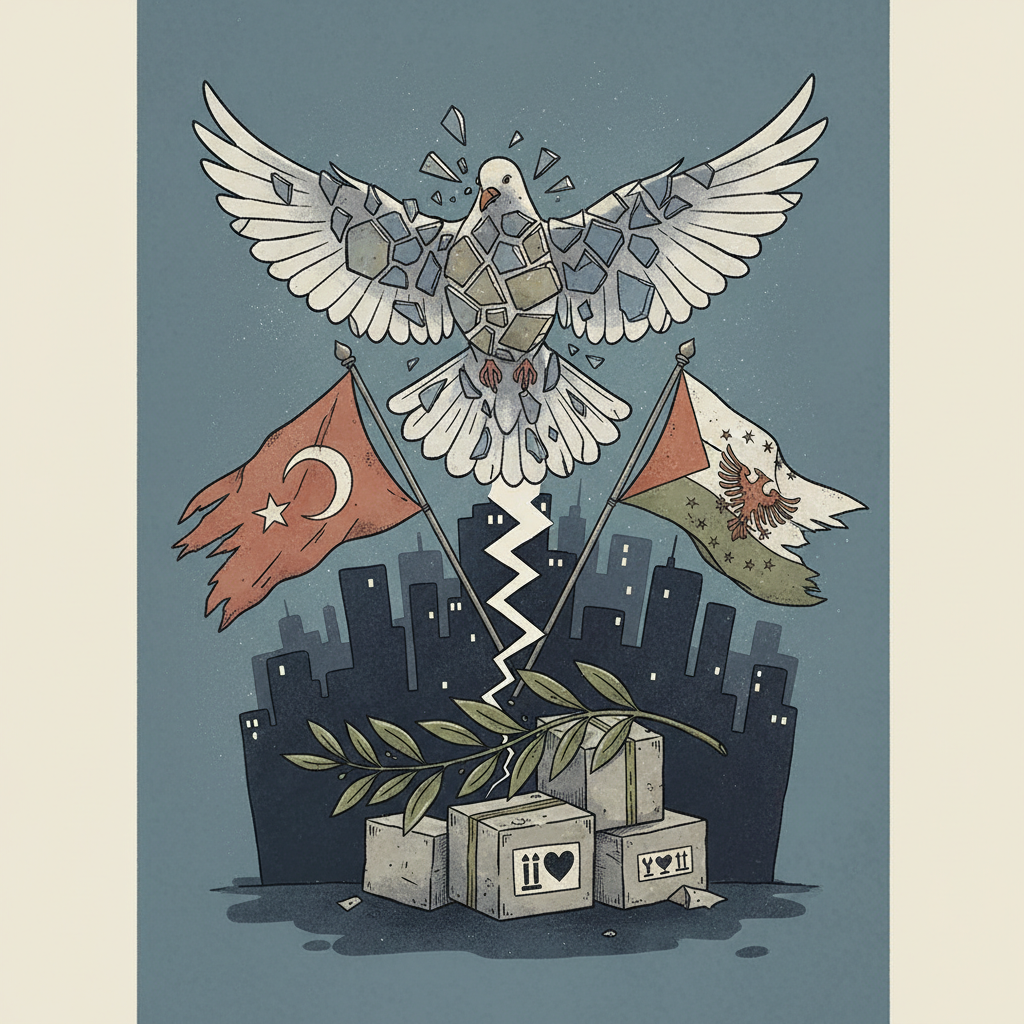
Historical Context and Origins
The roots of the Gaza conflict extend to the 1948 Arab-Israeli War and the 1967 Six-Day War, with Israel occupying the territory. After Israel's 2005 disengagement, Hamas's 2007 takeover led to an Israeli and Egyptian blockade. This blockade, intended to prevent weapons proliferation, has severely impacted civilians, creating conditions cited as triggers for escalation. History marks repeated large-scale military operations and rocket fire exchanges, underscoring a persistent cycle of violence.
Current Dynamics and Escalation
The conflict’s dynamic nature is evident in 100 recent events tracked by GeoGazet. Top connections by signal volume are Gaza (59 tracked signals), Israel (53 tracked signals), and Peace & Ceasefire (38 tracked signals), indicating intense monitoring. Recent signals illustrate severe impact: "Israel bombs Gaza after displacement orders, kills two Palestinians," and “‘There is no safe place’: Israeli attack kills family of six in Gaza.” These reports confirm continued civilian casualties and widespread devastation. A particularly concerning development is the signal, "‘Creeping death’: Israel weaponises ‘Yellow Line’ to annex Gaza," suggesting a potential shift towards territorial expansion. Despite intense local impact, GeoGazet reports the conflict's current global influence score at 2/100, indicating its immediate disruptive international reach remains comparatively limited.
Key Actors and Geopolitical Implications
Primary actors include Israel, Palestinian militant factions like Hamas and Palestinian Islamic Jihad. Regionally, Egypt mediates and enforces border controls, while other Arab states and Iran exert influence. Internationally, the United States remains a key Israeli ally, with the United Nations and European Union often focusing on humanitarian aid and peace efforts. The conflict continually strains regional stability, contributes to humanitarian crises, and fuels broader geopolitical tensions, impacting international discourse on human rights, self-determination, and security.
Historical Comparisons and Patterns
The current Gaza conflict exhibits parallels with previous large-scale escalations, such as Operation Cast Lead (2008-2009), Operation Pillar of Defense (2012), and Operation Protective Edge (2014). These historical episodes share common features: intense aerial bombardment, rocket fire, significant civilian casualties, and often fragile ceasefires. The "Yellow Line" signal introduces a dimension comparable to historical patterns of territorial demarcation or control, suggesting a potential long-term strategic objective beyond immediate military containment. This recurring nature underscores the failure of past and present strategies to achieve lasting peace or security.
What to Watch For Next
Future developments require close monitoring. Key indicators include the trajectory of diplomatic efforts, particularly those aimed at achieving peace and a ceasefire, as reflected by the 38 tracked signals on this topic. Further escalation, such as ground incursions or increased rocket barrages, will be critical. Humanitarian conditions in Gaza, including aid access and reconstruction efforts, will remain a focal point. Observers should also watch for reactions from regional and international powers, which could influence the conflict’s intensity and potential pathways to de-escalation or resolution.